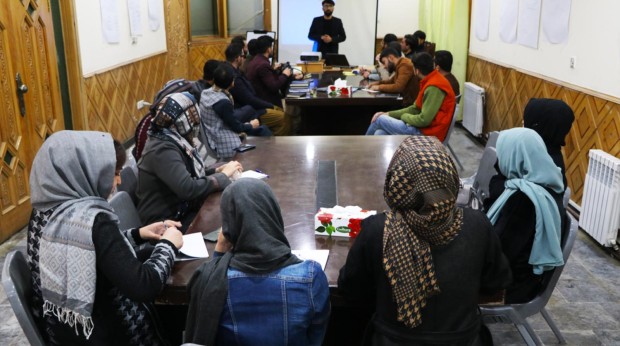

A Generation Abandoned: Insights from APT
In this article, Rahman Jalil, from Afghans for Progressive Thinking (APT) reflects on the five years since the Taliban takeover of Afghanistan, drawing on its direct work with Afghan youth and the perspectives they have shared through surveys, policy briefs, and advocacy initiatives. Through four interconnected dimensions - education, employment, civic participation, and international engagement - the article examines how a generation has faced increasing exclusion and abandonment, while highlighting the urgent need to recognise Afghan youth not merely as beneficiaries of international action, but as key stakeholders in shaping Afghanistan’s future.
"For me, this article is deeply personal because I still remember standing in Kabul on August 15, 2021, when the silence of the city told everything about what was being lost. Since that day, through my work with Afghans for Progressive Thinking (APT), I have listened to Afghan youth describe how that silence spread into their lives. Through this article, I am connecting my memories with the voices of millions of young men and women so the world can see their daily reality."
Rahman Jalil
Five Years of Abandonment: Afghanistan’s Lost Future
For the world, the tragedy in Afghanistan is strategic peril because a nation forgotten becomes a vacuum, its decisions made by a few, its destiny shaped by none. And vacuums, as history reminds us, do not remain empty. They invite troubles that sooner or later will spill beyond borders.
August 15th, 2021 – the streets of Kabul, Afghanistan, were silent as if everyone knew that they were witnessing the unraveling of events that might haunt them for a very long time. I was outside that day; it was 11:30 in the morning. All markets and shops closed not from the hour but from fear. We all witnessed the fall of other provinces during the past weeks but on that day, as Taliban were near the gates of Kabul, I sensed for the first time how the weight of fragile hope, the ink of promises written in peace agreements, the laughter of girls in streets, and the dreams of young men who believed their voices could matter, was crushing and collapsing.
What happened since that day, there might be one way to characterize it: the abandonment of a generation who was the very future of their country. To explain this paradox, I will highlight four axes through which even after five years, the consequences remain visible. As a program manager with Afghans for Progressive Thinking (APT), I have spent these past years working closely with Afghan youth. Through our initiatives, we have been amplifying youth voices and engage them in advocacy while advancing education and creating opportunities for learning across the country. We also provide platforms where they can come together to share their perspectives and shape policy briefs that reflect their urgent concerns.
Thus, the framing here is not only my observation but is deeply rooted in what Afghan youth themselves have consistently raised in our surveys and pieces throughout the five years, specifically the most recent policy brief, “The aftermath of the Taliban takeover: A generation erased”, where young people from different provinces described how the past years have felt like abandonment, an erasure of their hopes and opportunities. The axes mentioned here operate both singly and in tandem.
Education: The First Axis of Abandonment.
The silence I mentioned in the beginning first found its way into girls and young women’s classrooms across the country. In September 2021, after the Taliban takeover, we witnessed boys’ secondary schools reopening but girls’ schools (grades 7–12) remained closed. Now, even after 5 years, we hear one phrase from officials, ‘this is temporary’. In March 23, 2022, the Taliban Ministry of Education announced girls’ schools would reopen. Thousands of girls dressed in uniforms and walked to their schools that morning only to be turned away at the gates. This broken promise marked the formalization of the ban. In December 2022, a new decree extended restrictions to universities which suspended young women from acquiring higher education, erasing two decades of progress. By August 2024, UNESCO reported 1.4 million girls banned from secondary education with the total number of girls deprived of schooling reaching 2.5 million. Today, over 1,000 days have passed since girls’ secondary schools are closed. Afghanistan remains the only country worldwide prohibiting girls from education beyond primary level. Education was the axis through which Afghan youth could imagine a different country now its closure is a deliberate erasure of that possibility.
Employment: The Second Axis of Abandonment
Following the classrooms, the silence extended to women's workplaces. In September 2021, The Ministry of Women’s Affairs was abolished, removing the only government body dedicated to women’s rights. Soon, in the next three months, women were banned from long-distance travel without a male guardian which restricted their ability to work outside the home. This was not the end because in December 2022, a new decree banned women from working in NGOs, crippling humanitarian aid delivery because women in Afghanistan are essential to reaching female beneficiaries. In April 2023, the Taliban extended the ban to Afghan women employed by the United Nations and soon, in July 2023, beauty salons, where an estimated 60,000 women worked, were shut down nationwide, eliminating one of the last spaces for women’s economic participation. Today, women’s employment in government is 0% with only limited exceptions in health and primary education.
Civic Participation: The Third Axis of Abandonment
For youth in Afghanistan, the silence that began on August 15 has now spread its way into the public sphere, closing off the spaces where their voices once shaped society. By January 2022, Taliban effectively started suppressing public gatherings as dozens of activists were arrested. Between 2021–2023, over 80% of female journalists lost their jobs in media which meant erasure of youth voices in media. Today, Afghanistan’s political offices, ministries no longer included female representatives. For Afghan youth, the travel restrictions and lack of recognition prevent them from joining exchanges, conferences, or advocacy platforms. But this is not the only tragedy because there is something much deeper. It systematically dismantles the very mechanisms which a generation learns to govern itself. And when they are denied this ability, they are not merely excluded from politics, they are excluded from history.
International Engagement: The Fourth Axis of Abandonment
The silence now extends even beyond Afghanistan’s borders leaving young men and women in the country without international solidarity. Youth delegations from inside the country that once participated in UN forums and global conferences are no longer invited which further restricts activists and students to attend international exchanges, scholarships, or advocacy events. Today, we see how regional dialogues, peace process, and global conferences concerning Afghanistan continues without significant Afghan youth representatives despite the country having one of the youngest populations in the region. A generation cut off from the world will soon grow susceptible to forces that thrive in isolation, and this is like planting seeds of instability that will inevitably cross borders.
The Way Forward
After five years, almost nothing has changed—education for girls remains banned, restrictions on women’s rights continue, and Afghan youth are still silenced in public life. Yet, history will not excuse failure by the magnitude of the tasks. I have seen how the outside world speaks of our country as if it were a graveyard but they sadly forget that beneath the rubble there is a generation still breathing and waiting. The paradox discussed in this article is that Afghanistan’s greatest resource is its youngest population but it is precisely this resource that has been abandoned. Thus, the world should not only focus on aid or diplomacy from outside. I believe the cycle of abandonment will simply reproduce itself under new names and new actors if narrative in such contexts don’t portray and recognize youth as the main stakeholders by investing in platforms that connect them, amplify and publish their perspectives, and make sure their presence in regional and global dialogues. For us, youth who are grown in a country drowned in conflict and war, the question should no longer be whether we will survive. Because we will. The question should be whether the world will have the courage to listen to us.
For us, abandonment is never neutral. It is a choice, and choices, once made, echo across centuries. I see the choice before the world is very simple: either they will recognize Afghan youth as the architects of tomorrow or they accept that tomorrow will be built without them. And history has never forgiven those who abandoned its builders. Let’s not allow the silence which spread so fast in the past years to echo for decades for youth in Afghanistan. “Traveler,” says a Spanish proverb, “there is no roads. Roads are made by walking."
Bringing Hope and Light to the Lives of Women and Youth Amid Darkness